
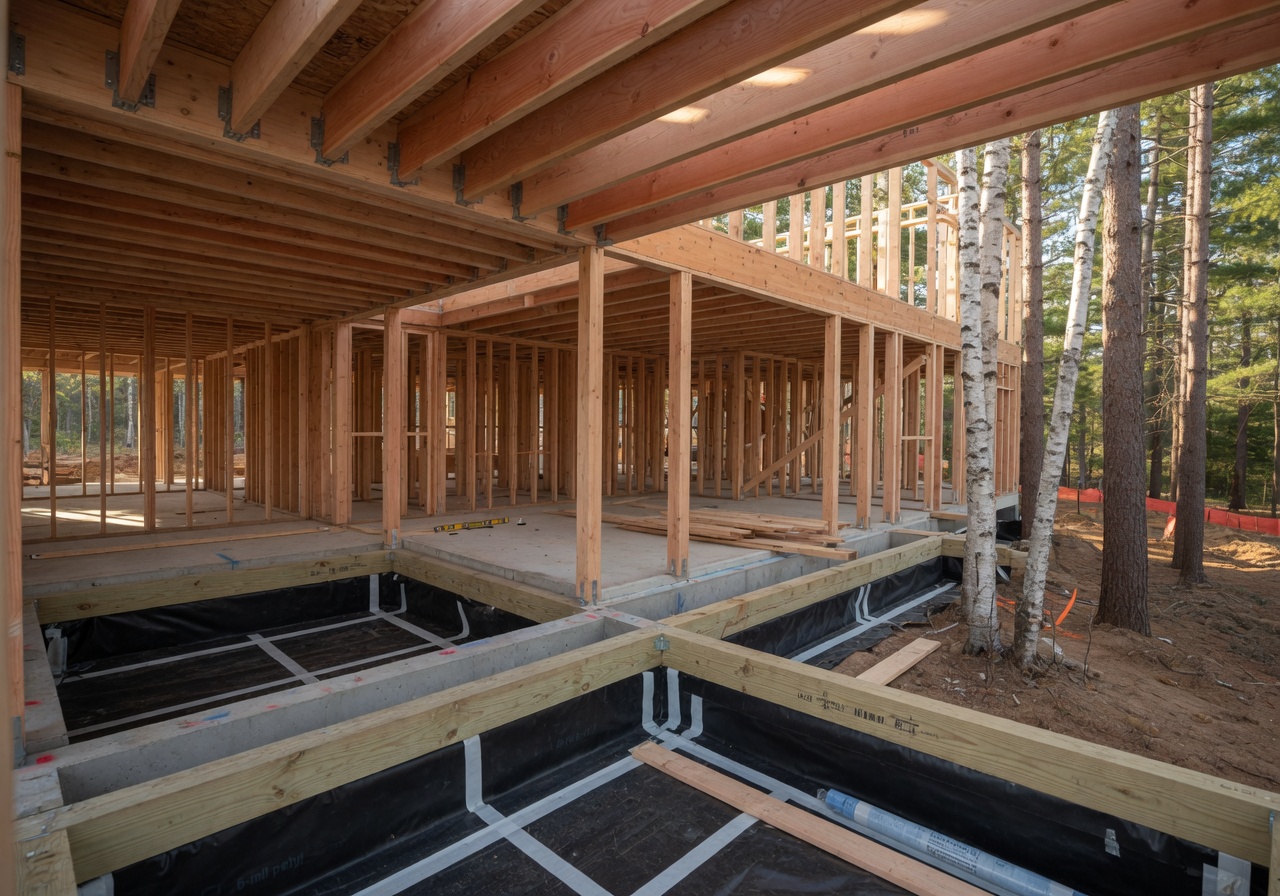
Embarking on a custom residential building journey is one of the most exciting endeavors a homeowner can undertake. In high-demand markets like Grand Blanc, Fenton, Tyrone Township, and adjacent Livingston County communities, the market for custom luxury construction continues to flourish.
However, building a high-end custom home in Michigan is uniquely shaped by our local climate, state-level regulations, and mechanical codes. To ensure a seamless project, there are several foundational rules and regional structural challenges that you and your builder must navigate. Below are the key building factors you must consider before breaking ground in Mid-Michigan.
1. Engineering for Cold Climates: The 42-Inch Frost Line
Michigan winters are famous for solid frost penetrations, which can cause significant shifting in soils if foundations are improperly laid. To prevent structural movement from frost heave, the local building codes mandates that all structural footings and foundation piers must be positioned at least 42 inches below final finished grade.
Ensuring your builder understands this requirement and has evaluated the natural slopes and contours of your lot is essential, especially when developing grand daylight or walkout basements along Michigan's rolling terrains and inland lake shorelines.
2. Navigating the New Michigan Energy & Residential Code Updates
Building standards are constantly evolving, and a major milestone was reached recently. Under the updated Michigan Energy Code and the 2021 Michigan Residential Code (which took official effect on August 29, 2025), newly constructed residential properties are subject to rigorous energy efficiency benchmarks.
These standards require improved ceiling and wall insulation values, advanced window thermal performance (U-factor), duct insulation, and comprehensive envelope air leakage testing (blower door metrics). Making sure your architectural design and 92%+ EFI HVAC systems are engineered to meet these strict state guidelines will save thousands in energy costs and prevent regulatory delay at final inspection.
3. Clay Soils & Moisture Control for Luxury Basements
The geology of Genesee County and neighboring Livingston County features high clay concentrations in multiple geographical pockets. Clay holds water longer than sandy loam, making proper basement waterproofing and drainage systems vital for custom builds.
For luxury homes where basement floors are often finished into high-end home theaters, wine cellars, or guest suites, utilizing premium damp-proofing materials, thick interior vapor barriers, exterior French drains, and moisture-resistant drywall is critical. We also highly recommend dual sump pump systems equipped with battery or water-pressure backups to guarantee piece of mind during heavy seasonal rains.
4. Soil Percolation Testing for Septic Suitability
Many of the finest larger acreage properties and luxury lake lots in Tyrone Township, Linden, and Lapeer County are positioned outside the reach of municipal sewer systems. If you purchase land in these areas, you will need a private septic system.
Before committing to a land purchase, your offer should always include a contingency for a successful soil percolation test (commonly called a "perc test"). A certified county health technician or environmental engineering company must evaluate the absorption rate of the soil on-site. If the soil does not perc successfully due to high clay depth or high water tables, an expensive engineered mound system may be required, which could impact your overall landscaping scope and project budget.
5. Seasonal Construction Schedules: Road Weight Restrictions
Timing is everything. In Michigan, the arrival of spring is accompanied by the "spring thaw," a period when melting snow saturates the roadbed beneath our regional highways and pathways, rendering pavements fragile.
To protect local roads, county road commissions enforce seasonal spring weight restrictions. These laws restrict heavy heavy-hauling construction trucks (such as concrete mixers or timber delivery trucks) on residential and gravel routes for several weeks, usually between late February and April. Builders must plan their gravel delivery, heavy excavation, and foundation pours meticulously around these annual restrictions to avoid weeks of standstill.
Partnering with Experienced Luxury Specialists
Developing a custom home in Southeast or Mid-Michigan requires a deep familiarity with municipal building divisions, zoning variances, and local geological patterns.
At The Moen Group, we maintain strong working associations with the area's premier custom homebuilders, local surveyors, and soil engineers. If you are exploring the idea of buying vacant acreage or building your custom dream home, our team can guide you through site selection, builder selection, and contract negotiation to secure your investment's future.
Related Services

Rob Moen
As the Principal Broker for Keller Williams First, Rob has spent decades working with developers and clients to design, market, and close high-end custom residences and premium new subdivisions across Mid-Michigan.